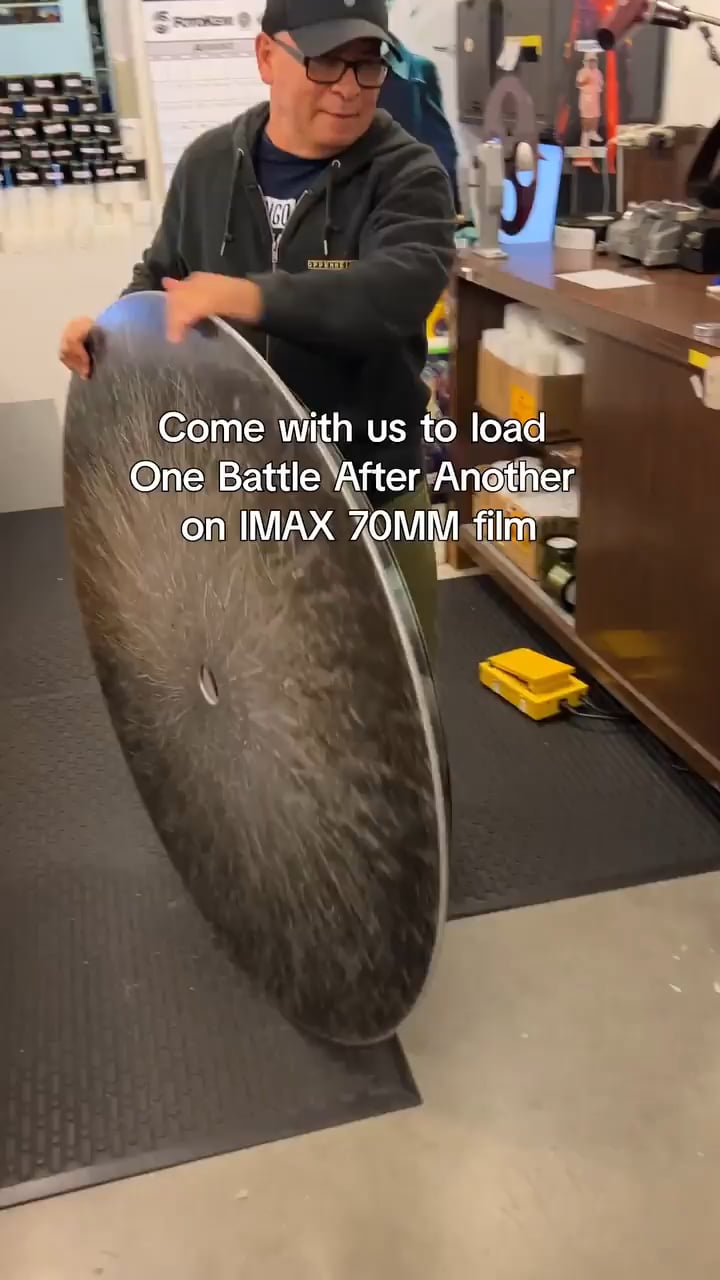
what I feel like when I accidentally walk in the room
nfoote on
Can anyone explain the why? What are all those different lengths and turns and rollers or whatever doing?
MrReginaldAwesome on
Why does it have to go be draped all around the room and go through some dipsy doodles before and after going to the projector?
ApprehensiveGur6842 on
Why does it have to be so complicated and move all over like that?
PacquiaoFreeHousing on
That’s 15/70mm film
It retains significantly more detail and resolution than standard film or even most digital formats.
Embarrassed-Grab-434 on
At first I thought the operator was walking in with a battle shield 🛡️ 😂
Oldest_Boomer on
That appears a little more complicated than my original Eumig Standard 8mm projector.
DukeShot_ on
Without gloves?
Won’t there be fingerprints?
Cessna152RG on
are all the long stretches to dissipate heat? It seems horribly inefficient, but there has to be a reason
HighlightOwn2038 on
I always wondered how they did it
Slimfictiv on
At first I thought he’s trolling…
Ok-Comfortable9449 on
I thought they just loaded a USB stick into the projector lmaoooo
Tight-Creme9037 on
Thank goodness it’s not a short film, because there wouldn’t be enough film to thread the projector!
Narcan9 on
Be kind, please rewind. 😃
oof46 on
“Can’t we make the reel go from point A to point B?”
“Well, yeah. But then, we wouldn’t need a specialist.”
Alert-Note-7190 on
Feels like a prank
Olly230 on
IMAX uses 15/70mm film—three times taller than standard 70mm—which weighs over 500 lbs per reel and runs at 5.6 feet per second, creating immense momentum and tension risks. A simple straight feed would cause film tearing, jamming, or projector damage from any minor fluctuation in speed or slack.
YeahBuddyDoYouEven on
The movie has already finished by the time the film is loaded
TheOnlyPolly on
If this is IMAX I wonder how complex Dolby Digital is!
naalotai on
Here’s a comment by u/Rampage_Rick from a year ago:
>>> The main reason for all those extra rollers is to manage the slack between the storage platters and the projector. The extra loops act as a cushion.
>
> For 70mm IMAX the film alone weights 500+ lbs and moves at 5.6 feet per second, so there’s a lot of momentum on those platters. If it came straight off and fed into the projector, any tiny hiccup could tear the film or damage the projector.
>
> Secondary to the slack, those platter racks (“Quick Turn Reel Unit”) can hold 4-5 platters, with the film spooling off of any one level and back onto any other level. Thus a few of those rollers are just to get the film alignment off and on to the correct levels.
>
> Thirdly, the green rollers near the back of the projector are sticky, and are meant to clean off any dust that’s on the film.
>
> Fun facts about the QTRU: They are operated via a Palm Pilot (or an emulated Palm Pilot on an iPad) and they use light bulbs from Mercedes
Lepista_nuda on
It’s not digital?
_InvaderJim on
Make sure not to let any moonlight touch that film~
As long as it removes the adverts at the beginning
Vilhelmssen1931 on
Why don’t they just make a giant TV and stream the movie, are they dumb?
Korimthos on
Is it all over the walls for cooling or something similar?
PerryHecker on
Makes me realize how little I know about film. I recently said I wouldn’t go back to a theatre until I could watch in something more than 240p but if they’re still loading up old reels like this on an obsolete platform then it’s understandable why it looks as bad as it does ig.
Acceptable_Foot3370 on
That’s a lot of work!
BarcaStranger on
I have sweaty hands i can’t do this job
NC16inthehouse on
This is why I love Tiktok. There’s always something niche or cool that someone does and you never thought or seen it before. I learned a lot of shit there too.
Napischu88 on
All that work just to be disappointed.
glassbeadgame42 on
Can anyone ELI5 why real film is used and not just digital? Probably must be picture quality, but how come picture quality is so much better with film or worse digital?
SoupSuey on
Well, this sure is fascinating to see, especially considering how excessively digital things are nowadays… but why is it so complicated? Doesn’t putting the film through this amount of rollers and loops and whatever cause accelerated wear and tear?
sleepyprojectionist on
IMAX projectionist is probably my favourite job that I have ever had.
I love 70mm.
Legitimate_Minute_16 on
Can’t they just stream it or something, why are they being so extra?
masshuudojo on
Help me understand… Why does it have to go through so many loops and gears? Doesn’t it increase the risk of tangling or breaking? I’m sure there’s a reason and a purpose.

37 Comments
Oh I’d mess that up ….

what I feel like when I accidentally walk in the room
Can anyone explain the why? What are all those different lengths and turns and rollers or whatever doing?
Why does it have to go be draped all around the room and go through some dipsy doodles before and after going to the projector?
Why does it have to be so complicated and move all over like that?
That’s 15/70mm film
It retains significantly more detail and resolution than standard film or even most digital formats.
At first I thought the operator was walking in with a battle shield 🛡️ 😂
That appears a little more complicated than my original Eumig Standard 8mm projector.
Without gloves?
Won’t there be fingerprints?
are all the long stretches to dissipate heat? It seems horribly inefficient, but there has to be a reason
I always wondered how they did it
At first I thought he’s trolling…
I thought they just loaded a USB stick into the projector lmaoooo
Thank goodness it’s not a short film, because there wouldn’t be enough film to thread the projector!
Be kind, please rewind. 😃
“Can’t we make the reel go from point A to point B?”
“Well, yeah. But then, we wouldn’t need a specialist.”
Feels like a prank
IMAX uses 15/70mm film—three times taller than standard 70mm—which weighs over 500 lbs per reel and runs at 5.6 feet per second, creating immense momentum and tension risks. A simple straight feed would cause film tearing, jamming, or projector damage from any minor fluctuation in speed or slack.
The movie has already finished by the time the film is loaded
If this is IMAX I wonder how complex Dolby Digital is!
Here’s a comment by u/Rampage_Rick from a year ago:
>>> The main reason for all those extra rollers is to manage the slack between the storage platters and the projector. The extra loops act as a cushion.
>
> For 70mm IMAX the film alone weights 500+ lbs and moves at 5.6 feet per second, so there’s a lot of momentum on those platters. If it came straight off and fed into the projector, any tiny hiccup could tear the film or damage the projector.
>
> Secondary to the slack, those platter racks (“Quick Turn Reel Unit”) can hold 4-5 platters, with the film spooling off of any one level and back onto any other level. Thus a few of those rollers are just to get the film alignment off and on to the correct levels.
>
> Thirdly, the green rollers near the back of the projector are sticky, and are meant to clean off any dust that’s on the film.
>
> Fun facts about the QTRU: They are operated via a Palm Pilot (or an emulated Palm Pilot on an iPad) and they use light bulbs from Mercedes
It’s not digital?
Make sure not to let any moonlight touch that film~
https://i.redd.it/k6jni5d2swag1.gif
He’s putting in some reel work there.
As long as it removes the adverts at the beginning
Why don’t they just make a giant TV and stream the movie, are they dumb?
Is it all over the walls for cooling or something similar?
Makes me realize how little I know about film. I recently said I wouldn’t go back to a theatre until I could watch in something more than 240p but if they’re still loading up old reels like this on an obsolete platform then it’s understandable why it looks as bad as it does ig.
That’s a lot of work!
I have sweaty hands i can’t do this job
This is why I love Tiktok. There’s always something niche or cool that someone does and you never thought or seen it before. I learned a lot of shit there too.
All that work just to be disappointed.
Can anyone ELI5 why real film is used and not just digital? Probably must be picture quality, but how come picture quality is so much better with film or worse digital?
Well, this sure is fascinating to see, especially considering how excessively digital things are nowadays… but why is it so complicated? Doesn’t putting the film through this amount of rollers and loops and whatever cause accelerated wear and tear?
IMAX projectionist is probably my favourite job that I have ever had.
I love 70mm.
Can’t they just stream it or something, why are they being so extra?
Help me understand… Why does it have to go through so many loops and gears? Doesn’t it increase the risk of tangling or breaking? I’m sure there’s a reason and a purpose.